Zaragoza, Teruel, Barbastro, Sabiñánigo, Villanúa, Morata, Andorra… Aragón said goodbye to the year running

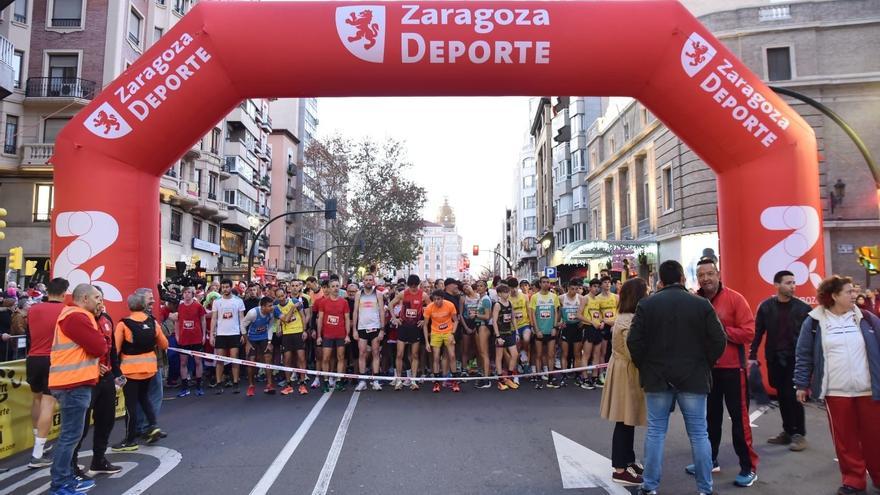
Thousands of people said goodbye to 2022 running throughout Aragon in the different San Silvestre spread throughout the community. The most massive was, once again, that of Saragossawhich brought together 3,628 people in an environment that was already completely normal after the pandemic years and, as usual, festive, with costumes as the main protagonists. Luis Pastor and Cristina Espejo they were the fastest to cover the five kilometers of the test, which passed through the center of the Aragonese capital. Among the participants, 2,157 were men and 1,471 women.
In a more playful than competitive day that is already a tradition, louis shepherd reproduction of the five kilometers of a fully urban and technical route in 13.53 minutes, three seconds faster than marcos crespo (Zenit La Mafia) and seven more than sergio del barrio (Alcampo Scorpio 71). christina mirror (Playas de Castellón) had no problem beating marta pintanel (Alcampo Escorpio 71) and his teammate Mireya Arnedillo. The winner will complete the circuit in 15.11 minutes, almost a minute faster than the second (16.04) and slightly more than the third (16.16).
There were more illustrious names among the participants, such as david cartiel (Zaragoza Athletics), who was seventh (14.01) or that of the brothers Osanzeighth and ninth at the finish line with Álvaro ahead of Daniel by a single second (14.04 and 14.05, respectively). Maria Jose Pueyo She was eleventh with 17.17 and Isabel Macías (Alcampo Scorpio 71), fourteenth with 17.28. the fireproof Luisa Larraga (Zaragoza Athletics) scored 19.37 at the finish line.
by clubs, the Casablanca Stadium Mapi topped the standings with a total of 23 athletes and an official time of 22.48, ahead of Zenit Atleet-La Mafia with 22 runners and 21.48 and the 10K club Zaragoza, which had 20 runners and a time of 31.33.
in Aragon
In the nineteenth edition of the San Silvestre de Jalon Morata there was a female record, with 30 runners out of the 200 total participants. Zakaria Boubekraoui prevailed over Sergio Latorre and Mustapha El Ouahabi, while in women the podium was occupied, in this order, emma perez, Isabel Linares and Lorena Plano. In the Puente Sardas neighborhood of sabiñánigo Virgina Sanromán triumphed over Karmele García and Leire Ramón, while Guzman Sanz he was faster than Markel Garaiun and Javi Almañac.
barbastro He used edition number 44 with a 5,000-meter route in which Hinaco Monzón did a double. armando garcia added his sixth victory, ahead of Fernando Esperanza and Luis Bandrés. in women martina laplana surpassed Marta Millaruelo and Lucía Gracia. is villanua there was record. Over a three-kilometre route, the Frenchman beat the best time kevin martins with a time of 8.23. He entered before Raúl Criado and José Luis Calvo. In women he won maite maiora to Leire Jaen and Alodia Martinez.
Andorra celebrated the 25th edition of its San Silvestre in style, which closed registrations by completing the 450 numbers available for a test that was held at noon on Saturday. In the female category forced first place Charlotte Gascon with a time of 7 minutes, the second was for Ana Castro and the third to cross the finish line was Raquel Quílez. Regarding the male category, the victory went to rich david, who crossed the finish line in a time of 5.51 minutes. The second to exceed the goal was Mario Miguel and the third classified, Pablo García.
is Teruel the win went to izan edo (Alcampo Scorpio 71) with a time of 18.04, ahead of Jaime Escriche and Maxime Janin. Elena Martin (Club Atletismo Alcorcón) was the fastest in women with 20.31, surpassing Erika Torner (Alcampo Scorpio 71) at the finish line. 230 runners participated.
CarlosMay
There were also Aragonese who ran outside the community. CarlosMay was sixth in the San Silvestre Vallecana which Joshua Cheptegei won by leading Mo Katir by ten seconds. In the Nassos course from Barcelona won the Ethiopian Adigh Girma with 13.25, while Pol Oriach He was seventh with 13.55 and second Spanish after Ilias Fifa, who entered second. In the Gipuzkoan test of beasainover 9,750 meters, the borjana Arancha Tejero he said goodbye to Zuera for military this year in Playas with a third place. The race was dominated by Morocco, with Aicha Bani being first and Kaoutar Boulaid second, and the 10,000 master world champion coming third.