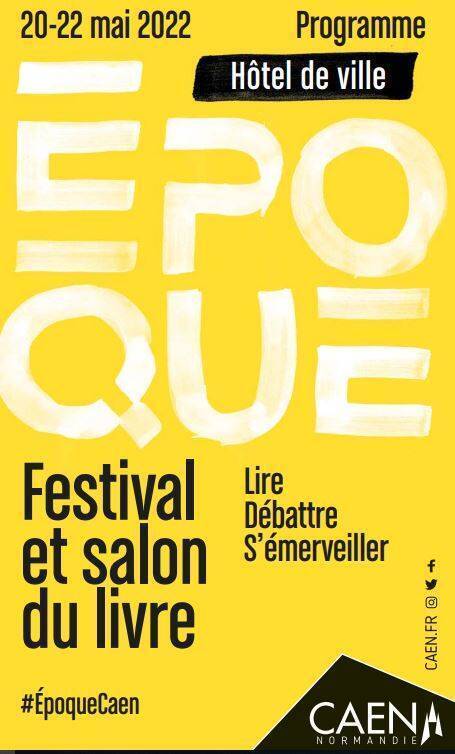
Period, festival and book fair

For its 8th edition, Époque, Caen book festival and fair, invite you to set sail. The edition pays tribute to Marcel Proust on the occasion of the centenary of his death and to Gisèle Halimi. The guest of honor will be Jeanne Benameur, writer with remarkable delivery, author of more than 40 novels, poetry collections and children’s books, she is part of a relationship
to the world and to human beings who love justice and freedom. His relationship to exile, to the sea, to the long term, to friendship, resonates particularly with the red thread of the festival.
The location of the events will be refocused around the Abbaye-aux-hommes, in the heart of historic Caen, in partnership with the surrounding cultural establishments: the Conservatoire de Caen, the Cité Théâtre, the Studio 24 and the Artothèque.
The Imec, the Alexis de Tocqueville library and the Lux cinema will continue to host part of the programming.
Youth area
The Duc-Rollon school, the Nature garden and the Duc-Rollon impasse will host spaces specially designed for families: outdoor stage, picnic area, relaxation and snacks, exhibition hall, workshop and animation, room dedicated to early childhood as well as an ephemeral theater and a space for dedication offered by the independent youth bookshop of the City.
On the program numerous meetings with writers Jeanne Benameur, Pierre Lemaitre, Nathacha Appanah, Pierre Assouline, Hélène Waysbord, Jean-Christophe Rufin, Lilia Hassaine, Christian Garcin, Sylvain Prudhomme, Belinda Cannone, Nathalie Cohen, Paola Pigani, Annick Cojean, Yahia Belaskri, Hubert Haddad, Franck Magloire…
Also many children’s authors and illustrators Gilles Abier, Manu Causse, Rémi David, Laurent Audouin, Nathalie Choux, Gaël Aymon and many others.
Comic book authors and designers will also be present, Christian Cailleaux, Florence Dupré La Tour, Laure Garancher, Léa Murawiec, Marcello Quintanilha, Christophe Regnault and Ennio Buf, Elene Usdin and many others will be present.
To note
Golden Gate Literary Prize on Exile
Sunday 22 May at 11.30 a.m. Town Hall, refectory room.
On the occasion of the festival, the Golden Gate literary prize on exile will be unveiled With the winner of the Golden Gate literary prize and Pap Ndiaye, historian (Black Americans, Tallandier; Black Condition. Essay on a French minority, Gallimard, 2009), general manager of the Palais de la Porte Dorée.
Moderated by Albert Dichy, literary director of Imec.
The Palais de la Porte Dorée, a former colonial museum built for the 1931 Colonial Exhibition in Paris, has since housed a tropical aquarium and, since 2007, the museum of the history of immigration. It has been directed since 2021 by historian Pap Ndiaye, who will be present in Caen this Sunday to reveal the name of the winner of the Porte Dorée literary prize. This prize rewards a novel or a story written in French dealing with the theme of exile.
Lectures on exile
Sunday, May 22, 2:30 p.m. Cité-Théâtre, 28 rue de Bretagne.
Directed by Céline Ohrel and Simon Grangeat.
Students from the theater section of the Conservatoire de Caen and the Cité-Théâtre read five texts on exile specially selected by the Reading Committee of the Comédie de Caen in connection with the red thread of Epoque: Les chants anonymes
(Philippe Malone), Pepper in the eyes (Simon Grangeat), The Earth between the worlds (Métie Najavo), American Dream (Nicoleta Esinencu) and Fire at night (Laura Tirandaz).
Led by Simon Grangeat, the Reading Committee, a veritable observatory of theatrical literary creation, receives more than 400 titles a year and carries out reading, scouting and circulation activities.
Five nuggets from the CDN library fund to hear about exile differently.
Find all the information on the Festival website: https://caen.fr/epoch