
Luxembourg 0 – 3 Rep. Ireland

Stephen Kenny’s hopes for a contract extension were bolstered of late when the Republic of Ireland claimed a 3-0 victory over Luxembourg in their World Cup qualification.
Goals from Shane Duffy, Chiedozie Ogbene and Callum Robinson in the final 22 minutes saw Ireland take the win – just Ireland’s second in a competitive game in 15 attempts – and third in the group Behind Serbia and Portugal.
President Gerry McAnaney and Managing Director Jonathan Hill take advantage of a delegation from the Football Association of Ireland at the Luxembourg stadium as they prepare to sit down to discuss Kenny’s future after a campaign that has gone bad started but ended in a more promising way.
Luxembourg played an important role in that terrible start, winning 1-0 at the Aviva Stadium in March, but although they were registered but correctly registered at 0-0, they never threatened to start again in front of a
crowd of 9,268 people in their new stadium.
In front of FIFA President Gianni Infantino – who was booed loudly by the crowd – and Grand Duke Henri of Luxembourg, Luxembourg goalkeeper Ralph Schon was the first to step into the action, diving on his left to fend off Robinson’s plunging strike in the ninth minute after the excellent Ogbene had been played in space on the lower right and delivered an inviting cross.
Adam Idah unsuccessfully appealed for a 14th-minute penalty after falling under challenge from defender Vahid Selimovic, Vahid Selimovic was not rewarded in the same way three minutes later after Maxime Chanot appeared to shoot his shirt after passing it.
Ogbene and Robinson’s pace and the breadth provided by James McClean caused real problems in Luxembourg, although the wrong footed Gavin Bazunu had to react intelligently to acrobatically repel Olivier Thill’s attempt from a distance after cutting Josh Cullen on the corn path. .
Gerson Rodrigues, who had scored five of his side’s eight goals for the campaign before kick-off, kept the Republic’s rearguard engaged with his clever movement and cunning while Thill was busy in midfield, but with little or no end product.
But Schon needed strong hands to deflect Ogbene’s rising push more than five minutes before the break, then reclaim John Egan’s lead, with Ireland looking most likely to find their way.
Idah landed a cross from Jeff Hendrick with Robinson perhaps better placed behind him and the Newcastle midfielder unleashed a shot from Matt Doherty as Ireland resumed with a real goal.
Doherty exploded high and wide at long distance with the increased momentum, although he might have died in the 54th minute when the home side thought they had gained the advantage.
Danel Sinani was well into his celebration after beating Laurent Jans’ cross in front of Bazunu, but Hungarian referee Tamas Bognar spoiled his evening by blowing for a foul on Duffy by substitute Maurice Deville during preparation.

Republic of Ireland manager Stephen Kenny could be in line for contract extension after strong World Cup qualifying end
Jason Knight, he then took the lead on Josh Cullen’s free kick, but could only help Duffy to the far post and he propelled him. in the net at close range.
It deepened seven minutes later when Hendrick spotted Knight’s run into the box and he daringly chased him down for Ogbene to lift the ball over the advancing Schon. tap into an empty net.
Reaction from the Republic of Ireland: Kenny and Ogbene
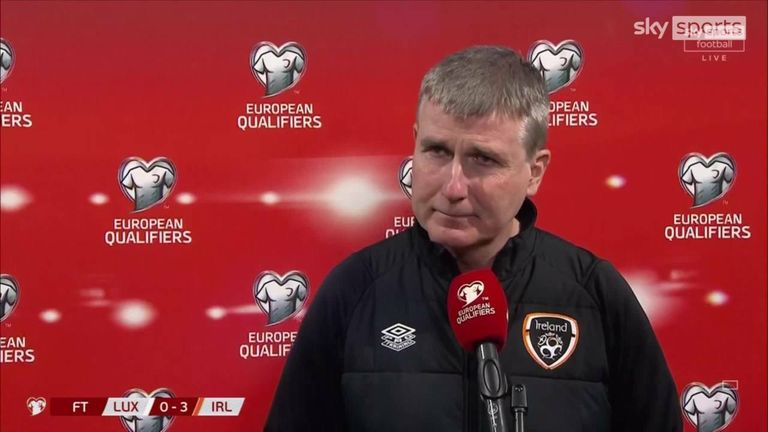
Stephen Kenny said his Irish side had always believed they could score after their 3-0 win over Luxembourg
Stephen Kenny said Air sports: “It was a tough game. They play good football. We felt they could bless us but we could bless them and exploit the full backs with rhythm. But we knew we could score, we created chances and we are happy to win.
“We entered several times. The last pass was not quite correct. It was quite open and frantic. We knew we just had to win the game, chase them and force the mistakes.
“One of the advantages of being a U21 manager before was that I knew the character of the players, I knew the strength and characteristics of Jason Knight. We are delighted to have it.
“Since we lost to Luxembourg and Portugal, we’ve been doing well. We know we are not perfect but there are players coming and more to come. There had been pressure on the players and they responded. It is a pleasure to work with them. It is a collective effort.
“I’d rather the fans sing about the players than me. I appreciate it, but it’s about the players. Ours have been magnificent in recent months. “
Chiedozie Ogbene said Air sports: “I’m delighted to be on the scoresheet, but I owe it to the team.
“We came here and got a 3-0 win and to keep a clean sheet away from a strong team. The game plan worked well and everyone dug deep.
“Credit to them” [the fans for coming out here, » he said. « It’s a cold place today. To come out and support us, we needed their support. You could tell towards the end of the game they were getting into it and they lifted us and we scored again to kill the game. »
Opta stats
- Republic of Ireland have won three of their last four matches in all competitions (D1), as many as their previous 22 beforehand (W3 D11 L8).
- Republic of Ireland have scored 20 goals in 12 internationals in 2021, two more than they scored in 27 games across 2018, 2019 and 2020 combined before this (18 goals).
- Luxembourg have lost 10 of their last 13 matches (W3) in qualifying for major international tournaments (World Cup & EUROs), also losing six of their last seven such fixtures at home (W1).
- Republic of Ireland have kept a clean sheet in four consecutive internationals under a single manager for the first time since October 2011, a run of eight under Giovanni Trapattoni.
- Shane Duffy has scored three goals in his last six internationals, as many as his previous 33 for Republic of Ireland beforehand. All seven of his senior international goals have been headed.
- Chiedozie Ogbene is the first player to score in both of his first two competitive away internationals for Republic of Ireland since Stephen Ireland in 2007. Ogbene has more goals in his five senior international games (two) than he does in 58 appearances in all competitions for his current club Rotherham United (one).
- Having only scored once in his first 20 senior internationals for Republic of Ireland, Callum Robinson has since bagged six in his last four for his country.