
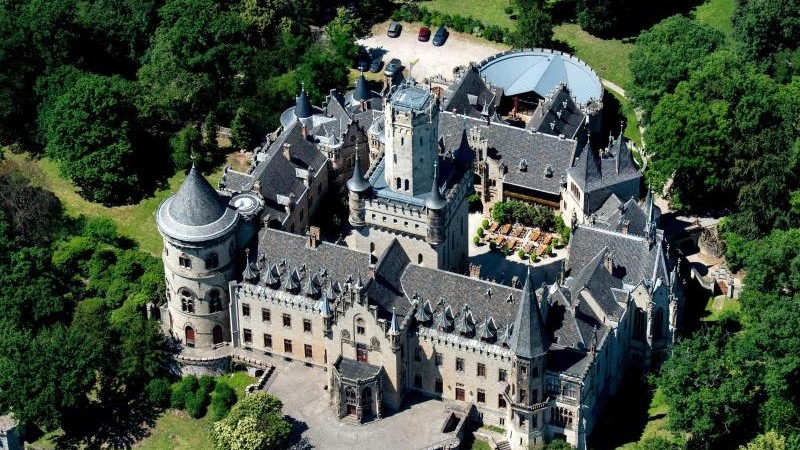
Monuments – Hanover – dispute over Marienburg: Guelph princes withdraw lawsuit – culture

Hanover (dpa) – A soap opera in the early evening program would not have made it any nicer. A father argues in court against his own son, it’s about works of art, antiques, land – and a fairytale castle. Specifically: The head of the Guelphs, Ernst August Prince of Hanover, reclaims the Marienburg south of Hanover from his son, Ernst August Hereditary Prince of Hanover – because of “gross ingratitude”. The oral hearing at the Hanover Regional Court WILL first be postponed by several months, then it will come. And then Princess Caroline of Monaco’s husband withdrew the lawsuit – shortly before the hearing on Thursday. The decision is to be announced on June 3rd.
Because the process is not over: Ernst August Senior sold his claims to the Salzburg EAH BetriebsgmbH, whose lawsuit is being heard. However, the presiding judge of the competent civil chamber, Stefan Heuer, expressed legal concerns about this assignment: “As of today, we would dismiss the lawsuit,” he emphasized. Also, “no gross ingratitude given”.
Because that is exactly what it is about: the head of the Guelphs had demanded the return of the castle, the Calenberg estate in the municipality of Pattensen-Schulenburg and the princely house of Herrenhausen in Hanover. The 68-year-old confirms his right to have a donation revoked as a result of “gross ingratitude”, unjust enrichment and the loss of the business basis. The 68-year-old had given the property to his son in 2004 and 2007 as an anticipated succession.
But the judge stated in his legal assessment: The 38-year-old son of the Welf chief was allowed to sell land on the Calenberg estate – especially since the sales were “economically advantageous”. An inviting of the assets of the House of Hanover was not ascertainable. Allegations that the hereditary prince did not take sufficient care of the seriously ill father, did not visit him at the bedside, are “far too general”. In view of the years of dispute, the 68-year-old “could hardly expect any more visits”. And: The Guelph boss is “no longer a child”.
The lawyer for the company, Volker Römermann, countered: Ernst August Prince of Hanover could not be named as a witness in his role as plaintiff – “now we will name him”. The court’s assessment that the sale of the Calenberg property had not caused any damage was “too easy”. The contracts are designed so that the head of the house in Hanover decides – and that is the 68-year-old. The decision is not up to the son, as in the case of Marienburg. Prof. Andreas Frieser, the Hereditary Prince’s lawyer, saw no solution in naming a witness to “unsubstantiated allegations”.
The hereditary prince explained in advance that the father’s lawsuit was “without substance and the allegations made therein are false”. But the dispute is much more than a family quarrel – it is about the future of Marienburg Castle. In 2019, the family hit the headlines because Ernst August junior wanted to sell the dilapidated castle to the public sector for one euro – against his father’s will.
But after the 68-year-old’s objection, the deal negotiated with the Lower Saxony state government fell through. Castle and inventory came into a foundation. According to the judge, the 38-year-old is protecting the assets of the House of Hanover, because the “renovation burden” of the castle is high at 24 million euros. Römermann emphasized that it is impossible to assume that the castle has no “material value” – the castle can also be sold for one euro. The father’s aim was to preserve the fortune for the coming centuries.
Whatever the case, the Hereditary Prince made it clear before the hearing: “There is no reason to worry about the future of Marienburg Castle.” The legal situation has always been clear in this regard – and it continues to be. “The foundation solution found with the state of Lower Saxony is legally secure; nothing stands in the way of preserving the Marienburg as a central cultural monument in Lower Saxony, which remains open to everyone,” he emphasized.
© dpa-infocom, dpa:220323-99-643366/6
/cloudfront-eu-central-1.images.arcpublishing.com/madsack/NUWZCWCJRJBIJHU5AUO5EXOHDY.jpg)

/cloudfront-eu-central-1.images.arcpublishing.com/madsack/NHW556UKZ5AVBM47OAWSYLJCPQ.jpg)