Sweden 1-0 Belgium: Late Sembrant strike beats Red Flames’ opposition

Linda Sembrant’s late strike broke a dogged defensive display by Belgium in the UEFA Women’s EURO 2022 quarter-finals at Wigan & Leigh, with goalkeeper Nicky Evrard in inspired form for the Red Flames.
Important moments
6′ Angeldal strike saved by Evrard
14′ Belgium No1 stops Ilestedt’s header
31′ Vanhaevermaet pulls the bet wide
34′ Blackstenius sticks straight at the goalkeeper
47′ Red Flames goalkeeper holds Rolfö volley
62′ Dipping Angeldal shot flies over the bar
73′ Blackstenius’ nod was dropped
82′ Dhont blasts into the side netting
90+2′ Sembrant pounces from close range
Match in brief: Sweden leaves it late
Belgium, in their first ever quarter-final at a major tournament, were under pressure from the start and had goalkeeper Nicky Evrard to thank as early as the sixth minute. The 27-year-old read the escape of Filippa Angeldal’s swinging strike from 20 meters excellently and pushed it out for a corner.
Soon after, Evrard was pressed into action again and made a smart reaction stop to deny Amanda Ilestedt’s powerful header. Angeldal, Sweden’s two-goal hero against Portugal on Matchday 3, was at the center of the attacking play when the blue and yellow peppered Belgium’s first-half goal.
Ives Serneel’s side rarely got out of defensive duties in the first half, but Justine Vanhaevermaet was able to fire in a sharp strike that skidded narrowly wide just after the half-hour mark. As half time approached, Stina Blackstenius was the latest to be denied by the Red Flames goalkeeper. The Arsenal forward attempted a corner from close range, but Evrard was able to produce a fine double save.
The second half continued in much the same vein, with Fridolina Rolfö’s instinctive volley the last Evrard collected. Sweden couldn’t keep up the attacking pressure, and Angeldal took a dipping effort from distance just after the hour mark that dipped just over the bar.

Evrard was once again congratulated by her team-mates with just under 20 minutes remaining when she headed home Blackstenius’ header from point-blank range. Belgium made an attacking switch midway through the second half, bringing on Elena Dhont, and the switch almost paid off with an 82nd-minute counterattack, but the substitute blasted into the side netting.
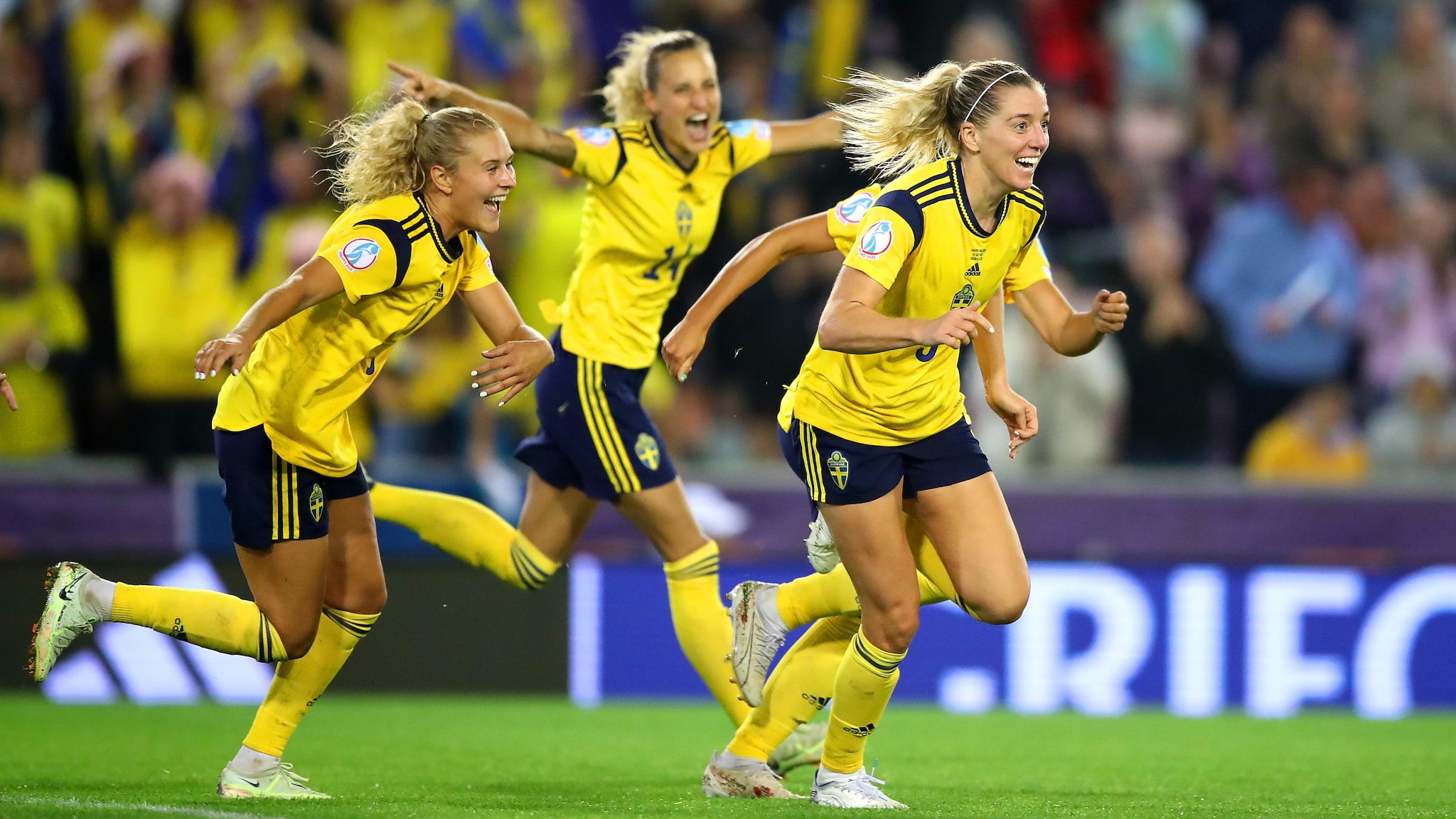
Time appeared to be running out for Sweden to avoid another 30 minutes, but the fastball specialists eventually broke down Belgium’s backline. A deep corner from the left caused problems, with Nathalie Björn denied by Evrard before Sembrant was perfectly placed to scoop the rebound into the roof.
Player of the match: Nicky Evrard (Belgium)
“She made some important saves and gave her side a lot of confidence playing from the back thanks to her excellent distribution.”
UEFA Technical Observer Panel
Alexandra Jonson, Swedish reporter
A huge sigh of relief at the end when Sweden finally got their winner. It was starting to look like it wasn’t going to be as they couldn’t find a way through despite dominating the game and having so many set pieces. They have many things right, but they will need to be more clinical against England in Tuesday’s semi-final.
Alyssa Saliou, Belgium reporter
Belgium can leave the tournament with their heads held high after this performance. They defended so well, only to be beaten straight at the end of a goal from a set piece. They kept pace with Sweden throughout and Evrard made some great saves to keep level, but even she couldn’t stop the last gasp.
Reaction
Peter Gerhardsson, Sweden coach: “We had chances in both halves. It took a long time [for the goal to come] but I think we worked very well and we were always a threat every minute.”
Linda Sembrant, Sweden’s defender: “We pushed really hard and in the second half we really went for the goal. It’s hard to describe my feelings when I saw the ball go in. It’s amazing, unbelievable and I just wanted to celebrate with the whole team so I ran towards the stands.”
Tine De Caigny, Belgium forward: “It’s not easy to go out like this. I want to be positive but you still have the emotions in the game, but I’m sure tomorrow we’ll just be very proud of ourselves and the group.”
Tessa Wullaert, Belgium forward: “We showed them who we are. It took them to extra time to score. That says a lot. We were down from the start but we did really well as a team. That’s what I want to remember from this tournament.”
Key statistics
- Sweden have failed to score in just one of their last 35 international matches.
- Sweden’s Kosovare Asllani is the only player to have been in all four quarter-finals since the stage was introduced in 2009.
- Blågult is through to its ninth semifinal in the women’s EC; only Germany (ten) has reached more.
- Sembrant became Sweden’s oldest women’s EC scorer, 35 years and 68 days old.
- Sweden has won its third women’s European Championship match in a row, equaling its best run in the tournament.
- Belgium played in their first knockout match for the Women’s European Championships.
- Belgium’s Ives Serneels took charge of her 33rd UEFA Women’s EURO match (including qualification) – taking her straight into sixth place in the all-time rankings.
Lineups
Sweden: Lindahl; Ilestedt, Sembrant, Eriksson, Nildén; Angeldal (Bennison 84), Asllani, Björn; Riding Kaneryd, Blackstenius, Rolfö
Belgium: Evrard; Deloose (Dhont 67), Kees, De Neve, Philtjens; Biesmans (Missipo 88), Vanhaevermaet, Minnaert; Cayman, De Caigny, Wullaert
What comes next?
Sweden face England in the first semi-final in Sheffield at 21:00 CET on Tuesday 26 July. The winners of that match will be the nominal home team in the final on Sunday 31 July at Wembley.